WNC COLLABORATIVE LAW SERVICES
TRAINED MENTAL HEALTH PROFESSIONAL NEUTRAL
What is Collaborative Law?
Collaborative Law is a voluntary, private process where couples work with a team of professionals to resolve their disputes without the threat of litigation. In the Collaborative model, you, your spouse, and your respective attorneys sign a Participation Agreement. This agreement is a commitment to transparency, mutual respect, and a promise that if the process breaks down and moves to court, the entire professional team must withdraw. This commitment ensures that everyone—lawyers and clients alike—stays focused on one goal: Resolution.
The Collaborative Law Interdisciplinary Team
In North Carolina, a Collaborative team typically consists of:
Two Attorneys: One for each spouse, acting as legal advisors and settlement specialists.
A Financial Neutral: A professional who helps gather data and create fair financial projections.
A Mental Health Professional (MHP) Neutral: This is my role.
Most people believe that divorce has to be a "battle" fought in a courtroom. Collaborative Law offers a different path.
My Role: The Mental Health Professional Neutral
Helping clients navigate divorce with dignity.
Divorce is one of the most emotional and vulnerable transitions we can experience. When emotions run high, the ability to make logical, long-term decisions for your family can be difficult. As your MHP Neutral, I am the steward of the "emotional space" in your case and strive to support you in moving forward. When you choose a divorce process that includes a MHP Neutral, you aren't just choosing a "friendlier" divorce—you are choosing a statistically more successful one.
How I Support the Process:
Neutrality is Key: I do not take sides or delve into deep clinical history. I am a neutral participant focused on the present and the future.
Communication Architecture: I help de-escalate conflict during meetings, ensuring that both parties can speak and be heard without the conversation collapsing.
Parenting Plans: I facilitate the creation of child-centered parenting agreements, helping you transition from "spouses" to "co-parents."
Process Efficiency: By managing emotional roadblocks in real-time, I help prevent the process from stalling, which ultimately saves you time and legal fees.
Research consistently shows that hiring a MHP for Collaborative Divorce leads to resulting legal and financial agreements that are more stable, more comprehensive, and more satisfying for both parties.
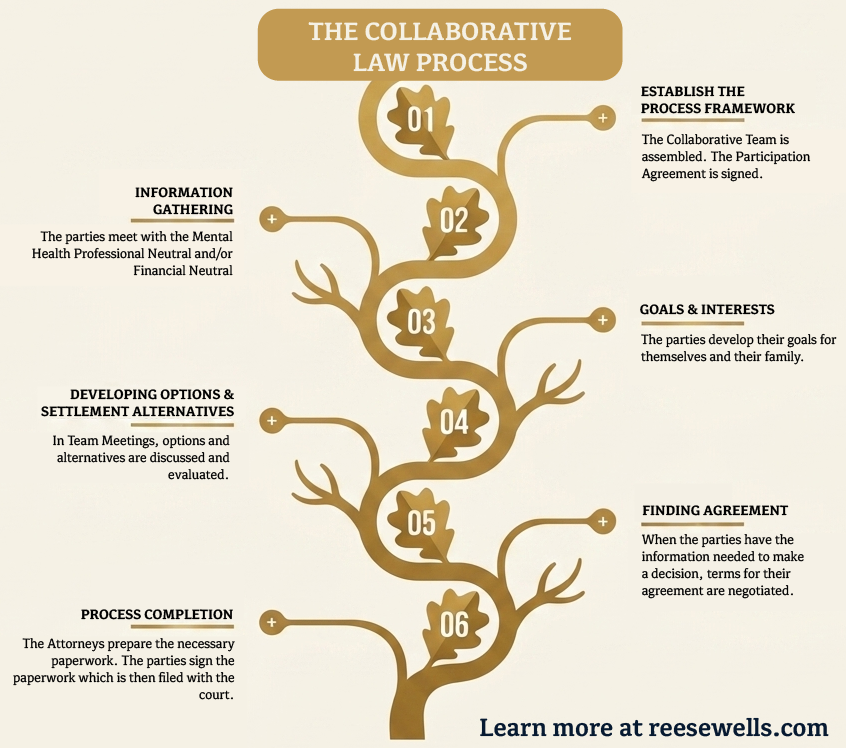
The Process: Your Journey Through a Collaborative Divorce
PRICING
As your MHP Neutral, I believe in a straightforward, transparent billing structure that allows us to focus on reaching a durable resolution for your family without the stress of hidden fees.To ensure we can move through the process efficiently and maintain consistent support for your collaborative team, I collect an initial retainer of $3,000 and bill at 6 minute increments at a total cost of $200/hr. If your case concludes and there is a remaining balance in your retainer, the difference is refunded to you in full.
How the Retainer Works
The retainer is not a flat fee; it is an initial deposit held in a dedicated account to cover my professional services as your Mental Health Neutral.
Free Initial Consultation: I offer a free 15 minute consultation that will help us determine whether or not we might be a good fit for working together.
Direct Billing: My time spent in collaborative meetings, coaching sessions, and communication with you and the collaborative team is billed against this retainer at my hourly rate.
Detailed Accounting: You may ask for a balance statement at any time so you can see exactly how your investment is being utilized to move your case forward.
Refundable Balance: One of the hallmarks of my practice is fairness. If your case concludes and there is a remaining balance in your retainer, the difference is refunded to you in full.
While adding a professional to your team may seem like an additional expense, an MHP Neutral often reduces the overall cost of a divorce. By handling the emotional and communication-heavy aspects of the negotiation, I help address expensive "logjams" that would otherwise result in significantly higher legal fees from your attorneys.
Ready to Choose Your Path?
If you’d like to schedule an Initial Consultation to see if Collaborative Law is right for you, please reach out.
What are the Benefits to Collaborative Law?
While the emotional benefits of Collaborative Law are profound, there are clear, practical advantages that make it a compelling choice for families. By moving the dispute from a public courtroom to a private conference room, you gain control over your finances, your schedule, and your family's future. Here is a breakdown of the primary benefits of the Collaborative model.
-
It is a common misconception that hiring a team of professionals is more expensive than hiring two litigating lawyers. In reality, Collaborative Law is almost always more cost-effective than a traditional court battle.
Reduced "Discovery" Costs: In litigation, attorneys spend thousands of dollars in "billable hours" chasing documents through subpoenas and formal requests. In Collaborative Law, both parties agree to voluntary disclosure, removing the administrative bloat of the court system.
Expert Sharing: Instead of each spouse hiring their own appraiser or actuary, the parties can share a single neutral expert (like a Financial Neutral), cutting those professional fees in half.
Avoiding the "Trial Tax": Preparing for a single day in court can cost tens of thousands of dollars in legal prep. Collaborative Law reallocates those funds toward finding solutions rather than preparing for a "fight."
-
In a traditional divorce, your personal life becomes a matter of public record. Anyone can walk into the courthouse and access filings that detail your assets, your debts, and even sensitive allegations about your character.
Closed-Door Negotiations: All collaborative meetings happen in private offices.
The "Inadmissibility" Rule: Under the North Carolina Collaborative Law Act, everything said or created during the collaborative process is confidential and cannot be used as evidence in court if the process fails. This allows for open, honest negotiation without fear that a mistake will be held against you in a later trial.
-
A judge’s order is a "top-down" decision; a Collaborative Agreement is made with everyone’s inputs understood and respected. Research shows that when people author their own rules, they are far more likely to follow them.
Customization: Judges have limited "cookie-cutter" options for asset division and custody. In the collaborative process, we can create creative, outside-the-box solutions that a judge simply doesn't have the authority to grant.
Lower Recidivism: Because both parties leave the process feeling the agreement is fair, the rate of "post-decree litigation" (returning to court to sue each other again) is significantly lower than in traditional divorce cases.
-
The North Carolina court calendar is notoriously backlogged. When you litigate, you are at the mercy of the judge's schedule, which can lead to months of waiting. In Collaborative Law, you and your spouse set the pace. If you need to move quickly because of a house sale, we can meet weekly. If you need a month to process the emotional impact of a decision, we can slow down. You are no longer a "file number" on a court docket.
-
For families with children, the divorce isn't an end; it’s a restructuring of the family system. Litigation is designed to make you adversaries, which often destroys the ability to co-parent effectively for years to come. Collaborative Divorce is a model for the future. The communication skills you learn during the collaborative process—facilitated by the MHP Neutral—become the foundation for how you will handle future graduations, weddings, and holidays together as co-parents.
By choosing this path, you are choosing a process that prioritizes resolution over retribution. It is a strategic investment in your family's long-term financial and emotional stability.
FREQUENTLY ASKED QUESTIONS
-
While I am a Licensed Mental Health Counselor, my role in your divorce is not clinical. In therapy, we look backward to heal deep-seated wounds. As a MHP Neutral, I am a "process architect." I use my clinical skills to help you look forward, manage high-stakes communication, and ensure that emotional triggers don't derail your legal and financial goals.
-
Yes. In the Collaborative Law model, each spouse maintains their own independent attorney for legal advice and drafting. My role is to support the entire team by managing the "emotional overhead," which often allows your lawyers to work more efficiently and cost-effectively.
-
Collaborative Law can be completed either in-person or virtually. As a MHP Neutral, I offer my services both in-person or through my secure, HIPAA-compliant virtual conferencing software.
-
This is exactly why I am in the room. Conflict is a natural part of this transition. My job is to de-escalate tension in real-time, facilitate "pauses" when needed, and help both parties return to a regulated state so that productive negotiation can continue.
-
The retainer is an initial deposit held to cover professional services. I bill my time against this deposit at $200/hour. You may ask for a balance statement at any time so you can track the progress of your case. If we reach a final resolution and there is money left in your account, the remainder is refunded to you in full.
-
Every family is different, but a typical collaborative case involves 3 to 6 "four-way" meetings. We may also have smaller "coaching" sessions in between to refine your parenting plan or prepare for difficult financial discussions.
-
Yes. Conversations during mediation are generally confidential and cannot be used later in court proceedings. This confidentiality allows both partners to speak openly and explore possible solutions.
-
No, it is optional. While many families find it helpful to have a neutral financial professional handle the complex math of asset division, we can structure your team to fit your specific needs and budget.
-
One of the unique features of Collaborative Law is the Participation Agreement. If either party decides to walk away and head to court, the entire professional team (including the lawyers and myself) must withdraw. This ensures that everyone stays "all-in" on reaching a settlement and protects the privacy of the work we have done together.