The Intersection Between Financial Health and Mental Health in Counseling WNC
Hi there, and welcome back to another month of LWC Therapies - the newsletter diving into my most recent interests related to the fields of mental health counseling, mediation, and collaborative law. If you’re new here, my name is Reese Wells and I am a licensed mental health counselor and trained Mental Health Professional Neutral for Collaborative Law. I am based in Asheville, NC. You can learn more about me and my practice at reesewells.com.
If you like what you read, please subscribe to this monthly newsletter and consider sharing this post. Our community is growing, and I’m glad that you are here.
How Does Financial Health Impact Mental Health?
Raise your hand if you’ve ever found yourself stressing about money. My hand is right up there with you. Now, raise the other hand if you’ve ever considered the impact of chronic financial stress on your mental health.
Let’s talk about why this is important.
There is a documented link between one’s financial health and mental health. How broad of an impact and how severe depends on the person. Everyone is different in:
How they experience stress, and
Their operating definition of financial security.
Your experience of financial security is linked to your sense of safety. I believe that we are conditioned in the United States to think about money in a way that deeply affects our sense of daily wellbeing and definitions of ‘success’. These thoughts then trickle down into feelings of comparison, which impacts our core needs for safety.
But does it have to be that way?
This is where things get complicated. There is conflicting research around the ‘ideal income for happiness.’ In 2010 that number was $75,000, however, in 2020 the Wharton School published a piece indicating that higher incomes yield greater moment-to-moment happiness and overall wellbeing.
So what do we do about that in a society where, depending on a variety of factors including (but not limited to) race, generational wealth, generational trauma, and education, it is really challenging to break through predetermined ceilings of class and income?
This is what I’ll say: we aren’t going to tackle the systemic issues associated with sociocultural income inequality today. My encouragement for this newsletter topic is to consider your feelings about wealth. And if you take nothing else away from this month’s newsletter I hope that you remember this: Every person has a different relationship with money and every person experiences financial stress differently. It’s a matter of perspective. Of past experiences. Of stress tolerance. Of goals.
I am fascinated by how we think and feel about money. This month’s newsletter will offer the following:
An opportunity for you to examine your relationship with money from a different perspective (or two).
Resources related to understanding the researched effects of financial instability on mental and emotional health.
A norm-busting book called The Psychology of Money, where Morgan Housel dives deep into how we think about money and how that affects our lives.
Think about it from an Evolutionary Psychology Perspective
Evolutionary psychology presumes all behaviors are born from survival instincts that have helped us endure to this moment in time. Those biological processes are still engaging in the vital act of attempting to keep us safe, even as the environment rapidly changes around us. Consider how your relationship with money has become a fight for survival. Without money, your most basic needs would not be met. Your survival would be threatened.
Now consider how we amplify the intensity of that need with negative emotions like shame, guilt, and fear through persistent messaging from family, friends, and media.
Our drive to survive is hard-wired into our genetic coding. Ask yourself these questions to get an idea of your tie between money and survival:
How has my relationship with money become a part of my survival strategy?
What have been the negative consequences of this relationship with money? Is there anything here that I can shift?
Remember that everyone’s survival instincts are different based off many factors, including some of the following: genetics, family history, social conditioning, and culture.
Can you acknowledge how your drive to survive has kept you safe? Maybe it’s even helped you thrive financially? So, at what point can you take the foot off the gas? That’s where Morgan Housel comes in.
Book Review: The Psychology of Money
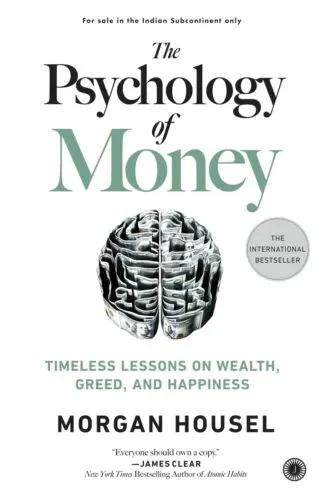
The Psychology of Money by Morgan Housel is a bestseller for good reason. Rather than supplying you with formulas and ‘infallible’ investing schemes he talks about our mental and emotional relationships to money. The main takeaways from this book that have stuck with me are as follows:
‘The hardest financial skill is getting the goalpost to stop moving.’ (Chapter 3: Never Enough)
‘Control over doing what you want, when you want to, with the people you want to, is the broadest lifestyle variable that makes people happy.’ (Chapter 7: Freedom)
‘Use money to gain control over your time.’ (Chapter 19: All Together Now)
How do you leverage your money to increase your sense of freedom and independence? How are the decisions you are making (financial, social, practical) enhancing or taking away from your feelings of freedom?
A Quick Anecdote: At the beginning of this month, I co-facilitated a presentation at a local school on managing student screen time. During the presentation we asked our audience of concerned parents - ‘What was your original intention for giving your child access to technology?’.
This book has helped me consider a similar question about finances: ‘What was my original intention for going into the workforce to make money?'
Today, I ask you how far have you strayed from your own original intention, and what have the consequences (both positive and negative) been from that subtle drift?
Monthly Mindfulness: 5-4-3-2-1
The 5-4-3-2-1 is a favorite of mine. It helps me get out of my head and back into the present moment by engaging all five of my senses. I find that it’s especially helpful if I am in negative thought patterns like catastrophizing (imagining the worst case scenario) or looping (repeating the same unhelpful thought again and again).
Here is the format I follow. It should take no more than 1-2 minutes. Take a deep breath, then name:
5 things that you can see
4 things that you can touch (around you or on you)
3 things that you can hear
2 things that you can smell
1 thing that you can taste
Then, take a deep breath and see how you feel now. We will do a quick demo in the video below.
So, what now?
If you are interested in this space, keep reading! And if you have people in your life who you think may be interested as well, consider sharing this post. You are welcome to subscribe to my newsletter, where these posts will be delivered to your inbox. However, please note that this platform is not HIPPA-compliant, and therefore your presence on this newsletter (likes, shares, subscription, etc) is not confidential.
And, if you would like to work together and are ready to reach out to schedule a free initial consultation, you may do so below.