Managing Existential Dread and Existential Anxiety through Counseling
Hi there, and welcome back to another month of LWC Therapies - the newsletter diving into my most recent interests related to the fields of mental health counseling, mediation, and collaborative law. If you’re new here, my name is Reese Wells and I am a licensed mental health counselor and trained Mental Health Professional Neutral for Collaborative Law. I am based in Asheville, NC. You can learn more about me and my practice at reesewells.com.
If you like what you read, please subscribe to this monthly newsletter and consider sharing this post. Our community is growing, and I’m glad that you are here.
Intentions for this Article
This topic is very important to me. However, I feel challenged in the attempt to link systemic issues plaguing our global health to one’s individual wellbeing. Therefore the scope of this article will be narrow and focused on the following:
An operational definition of Existential Dread (ED).
An exploration of how the Human Condition affects us all in unique and meaningful ways.
An introduction to the concept of ‘Allostatic Load’ and how it may relate to the intensity of feelings of dread.
A list of questions for you to examine how ED may or may not play into your sense of mental, emotional, or spiritual wellbeing.
Resources for further education on this topic.
A layered difficulty in writing has been navigating my own activated nervous system regarding existential dread. For me this topic is a personal bogeyman, a shadow-figure threatening my perceived sense of safety. To work with it head-on has been challenging and also, in its own way, relieving.
So here’s a reminder to take care of yourself and read at your own comfort level, as this article will will touch on ideologies regarding gun violence, climate change, political instability, and other social issues present in our society today.
What is Existential Dread?
I can’t offer a better definition for existential dread than the American Psychological Association’s:
‘A profound, deep-seated psychic or spiritual condition of insecurity and despair in relation to the human condition and the meaning of life.’ - American Psychological Association
Note the use of the word ‘spiritual condition’. For those who struggle with the word ‘spirituality,’ I encourage you to think of this as a sense of connection to, or disconnection from.
Someone who is experiencing heightened existential dread is likely feeling disconnected from what I call ‘life’s cornerstones,’ which have brought them a sense of security in the past. Often these cornerstones are represented by personal and shared beliefs about people, places, activities, communities, etc. When it is perceived that these belief systems are under duress, or the cornerstones are threatened, dread spikes.
And when there is a mass event affecting the entirety of a community, population, or society, it creates an existential experience that is then tied into ‘the human condition.’
The (My, Your, Our) Human Condition
It’s my belief that right now - today - is a very hard day to be a human.
What do I mean by that, specifically? I believe that regardless of your level of privilege and regardless of your life experiences there are hardships unique to you that are especially challenging.
It is tempting to get lost in the weeds of defining challenges, scaling them, and quantifying them in order to represent all populations who struggle for different reasons within the structures of our society. That is outside the scope of this article. Rather I want to put forth the idea that life is challenging, regardless of who you are and where you have come from. If we can accept that every person uniquely struggles, then it ties us into the humanity of each person’s life, leading to an increased sense of global empathy that becomes a source of compassion for the existential crises weighing on each of our souls.
Existentialism touches all, but in different ways. Often that is tied to one’s identity, which is why conversations I have with clients about the recent reports on gun violence in America, or the latest climate change data, or growing fears of political instability and how that affects our state of democracy look different session to session. One’s cultures, genders, ages, ethnicities, political orientations, upbringing, social development, and intergenerational history affect their identity and thus how they feel about these issues.
Existential dread does not have to be shared by the entire global population, but can pervade different ideological groups, which is one of the reasons why in US politics, for example, Democrats and Republicans feel so strongly about their ideological social issues and so frustrated with the other party for not experiencing that same level of concern.
How I approach these conversations as a clinician goes several layers deep.
First, I must make sure that I am managing my own existential fears, my own biases, and my own orientations to the world so that I can fully align with my clients and their unique views.
Second, I think about Individuals within Systems: we start with the individual and work up to larger systems, then ideally scale it back down to what is within the individual’s control.
Third, I consider my client’s allostatic load, and how this load may be contributing to the intensity of their existential dread.
The (My, Your, Our) Allostatic Load
A 2021 metanalysis by Guidi et al. titled Allostatic Load and Its Impact on Health: A Systematic Review is worth the read. In it they define allostatic load:
‘Allostatic load refers to the cumulative burden of chronic stress and life events. It involves the interaction of different physiological systems at varying degrees of activity. When environmental challenges exceed the individual ability to cope, then allostatic overload ensues.’
When I read this definition, something clicked into place for me and my conceptualization of existential dread.
One of the reasons I believe life feels so challenging right now is the cumulative burden of these existential stressors. Articles like this one - Allostatic load in the context of disasters, by Sandifer et al - are recognizing the adverse effects on people’s physical, mental, and emotional health when we stack crises on top of one another.
And don’t forget - discovering fresh crises are just a few clicks away. With for-profit news outlets using research-tested tactics to increase fear as a way to generate traffic (and thus revenue), we are constantly at risk of adding to the burden of our allostatic load, leading to chronic anxiety, stress, and a baseline level of fear that is increasingly more difficult to fully flush out of our system.
So… how do we return to normal? But wait. What is normal anymore?
Book Review: The Myth of Normal
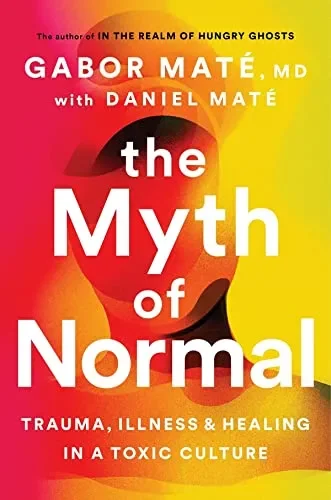
The Myth of Normal, by Dr. Gabor Maté and his son Daniel Maté, is an ambitious attempt to diagnosis the root issues plaguing our society. Their thesis is devilishly simple, belying a complexity requiring over 500 pages (or 30 hours of audio) to fully unpack.
This is how I interpreted their main thesis: Systemic issues have a direct influence on our physical, mental, emotional, and spiritual health. This creates a feedback loop where the poorer health of society leads to the poorer health of the individual, leading to even worse health of the society, and so on.
The image that comes to mind when I conceptualize this feedback loop are conjoined spirals increasing in entropy with each cycle.
I had to read this book slowly to let it fully sink in. I am sensitive to such topics, and read it 10 pages at a time over two months. What I took away were the following:
We exist within broken systems.
Those broken systems have an adverse effect on our mental, emotional, physical, and spiritual well-being.
We attempt to manage our struggles through both healthy and maladaptive coping mechanisms. The health of these coping mechanisms is dependent on a multitude of factors, many of which are outside of the individual’s control.
There is a path to wholeness, but it likely must begin with the individual and then move to the collective, and then back down to the individual, decreasing the chaos with each new feedback loop.
Monthly Mindfulness: Harnessing Hope
The question that I keep returning to is ‘How do we find hope in a world that at times feels hopeless?’ Often when I hear a client feels hopeless they are feeling a lack of control in one or several areas of their life.
The mindfulness exercise for this month is, then, when you are feeling hopeless, or helpless, or like you lack control over a systemic issue like our changing climate or political systems, can you bring it back to what I can control?
These are the questions I ask myself:
What is happening in my body right now?
What emotions am I feeling?
What was the triggering event? (IE - what was I thinking about, talking about, reading up on, watching, scrolling through, etc.)
What is this anxiety or dread attempting to tell me?
What can I currently control within this process?
What is a way I can foster a sense of hope right now?
In my experience the first five questions are easier to answer than the sixth. It can be challenging to feel hopeful when caught in the throes of existential anxiety. But there are a few tools that have been helpful for me. These include:
Writing down things I am grateful for.
Writing a letter to a close friend.
Calling someone I care about.
Taking Joe outside and witnessing his absolute joy for playing ball. Ball is life.
Exercising for 5 minutes.
Singing Lion King very loudly in my best Pumbaa voice.
Really what I’m getting at here is this - What is within your control? What is a way that you can harness some childlike energy and creativity? Can you make your world seem a little smaller, and a little safer, if only for five minutes? And can you notice the sense of relief that may accompany taking some weight off that allostatic load for those few minutes?
So, what now?
If you are interested in this space, keep reading! And if you have people in your life who you think may be interested as well, consider sharing this post. You are welcome to subscribe to my newsletter, where these posts will be delivered to your inbox. However, please note that this platform is not HIPPA-compliant, and therefore your presence on this newsletter (likes, shares, subscription, etc) is not confidential.
And, if you would like to work together and are ready to reach out to schedule a free initial consultation, you may do so below.