Counseling for the Polyamorous (ENM) Community in Western NC
You have likely heard the terms ‘Consensual Non-Monogamy’ (CNM) or ‘Ethical Non-Monogamy’ (ENM). Whether this came up during conversations with peers exploring polyamory, on dating app profiles, or in the news as a trending topic, non-monogamy is growing in the public sphere.
I work with several clients who are either actively in polyamorous relationships or are curious about being in one. For some, that looks like being partnered with multiple people and for others, it’s simply opening their relationships up to new experiences. It’s important to recognize that ENM looks different for every person and every relationship.
My goal as a counselor is to understand each of my client’s world views so that I can better align with them and their goals for counseling. Thus, educating myself about ENM has been a priority this year as more clients practicing polyamory have come through my door.
So, before we dive in, here are my hopes for this month’s newsletter:
If you identify as polyamorous - I hope that you find the available resources useful in bolstering your idea of healthy relationships.
If you identify as monogamous - I hope that you can approach this topic through a lens of curiosity to better understand the polyam community and how people are able to successfully manage multiple relationships through assertive communication and self-work.
If you’re not sure where you’re at with monogamy or polyamory - great! I hope that the newsletter is a safe launching point for your own exploration.
Whether you are happily monogamous or currently dating multiple people, it’s my belief that there are universal lessons for life and relationship that can be learned in the polyamorous teachings.
First, Check in with Yourself
As we are diving in, check in with whatever is coming up for you. Relationships and sex are tricky subjects that can elicit strong emotions. Consider sitting with the following questions:
What happens in my body when I think about polyamory? Is there tightness, warmth, or tingling? Where is this showing up in my body?
Where do my thoughts go when I consider ENM? Am I thinking about myself, or others?
What have people told me about polyamory in the past? How has this information informed my present opinion of it?
What biases do I have concerning ENM? How do these biases affect my beliefs about relationships?
By understanding our thoughts, emotions, and beliefs we are better equipped to understand our responses to challenging topics like polyamory.
Book Review: The Ethical Slut
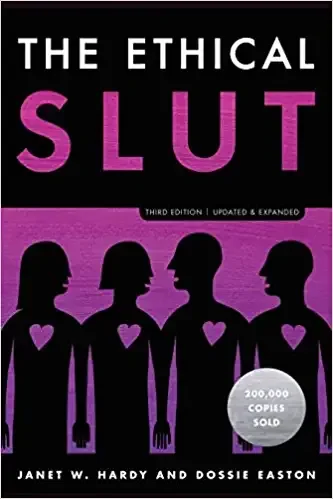
Now in its third edition, The Ethical Slutis widely considered, as one of my clients put it, ‘as the polyamorous bible.’ Hardy and Easton offer a glut of information regarding different coupling opportunities, common issues in ENM relationships, and ways to dip your toes into polyam communities.
I like this book for a few reasons:
It is written to be very accessible for all people, and takes in multicultural considerations for different populations.
It offers a useful blend of first-hand experience and case studies.
Hardy and Easton are advocates for creating a ‘Culture of Consent’ while also battling sex negativity experienced in American culture.
At times, I struggled with what I experienced to be a chaotic writing style that affected my ability to track information. I also wanted more research and clinical findings and fewer personal accounts.
I would recommend this book to anyone who is either (a) considering stepping into a polyamorous relationship, or (b) wants to better understand people in their lives who are currently practicing ENM. This book is wonderful at addressing biases regarding polyamory.
Article Review: “Counseling the Polyamorous Client: Implications for Competent Practice”
Adrianne L. Johnson’s 2013 article is an excellent introduction for anyone seeking a baseline understanding of polyamory. Though this article is written for mental health providers, my belief is that there is useful information for broader audiences.
I 10 out of 10 recommend giving it a read for the following reasons:
The clear operating definition of what polyamory ‘is,’ and what it ‘is not.’
A detailed list of possible presenting client issues that could be a part of their polyamorous experience.
Common implications for counselors, which may include: counselor bias, values system conflicts, and pathologizing.
I personally found the counselor implications most helpful for me. An ongoing part of my growth is acknowledging biases that may emerge due to my upbringing and socialization. The more awareness I can have around my biases the better I can show up for my clients in session from a non-judgmental and open-hearted way.
Monthly Mindfulness: Box Breathing
Box breathing, also known as ‘square breathing,’ is a breath exercise that is designed to lower your current emotional state while also training your stress response system for the future. The box breath is done in four stages of equal length: inhale, hold, exhale, hold. The slower breath is what calms your emotional state. The hold after the exhale increases your resilience to your stress response. Check out the video below for a quick demo on box breathing.
So, what now?
If you are interested in this space, keep reading! And if you have people in your life who you think may be interested as well, consider sharing this post. You are welcome to subscribe to my newsletter, where these posts will be delivered to your inbox. However, Please note that this platform is not HIPPA-compliant, and therefore your presence on this newsletter (likes, shares, subscription, etc) is not confidential.
And, if you would like to work together and are ready to reach out to schedule a free initial consultation, you may do so below.